

THE SHORT ANSWER
Not Every Concrete Slab Needs Traditional Rebar
Modern concrete reinforcement methods — like internal fiber reinforcement — can be the right engineering choice depending on the application, soil conditions, and load requirements. Here's what you need to know about when and why contractors choose alternatives to rebar, and how fiber reinforcement concrete solves real problems on the job site.
TECHNOLOGY OVERVIEW
What Is Fiber Reinforcement Concrete?
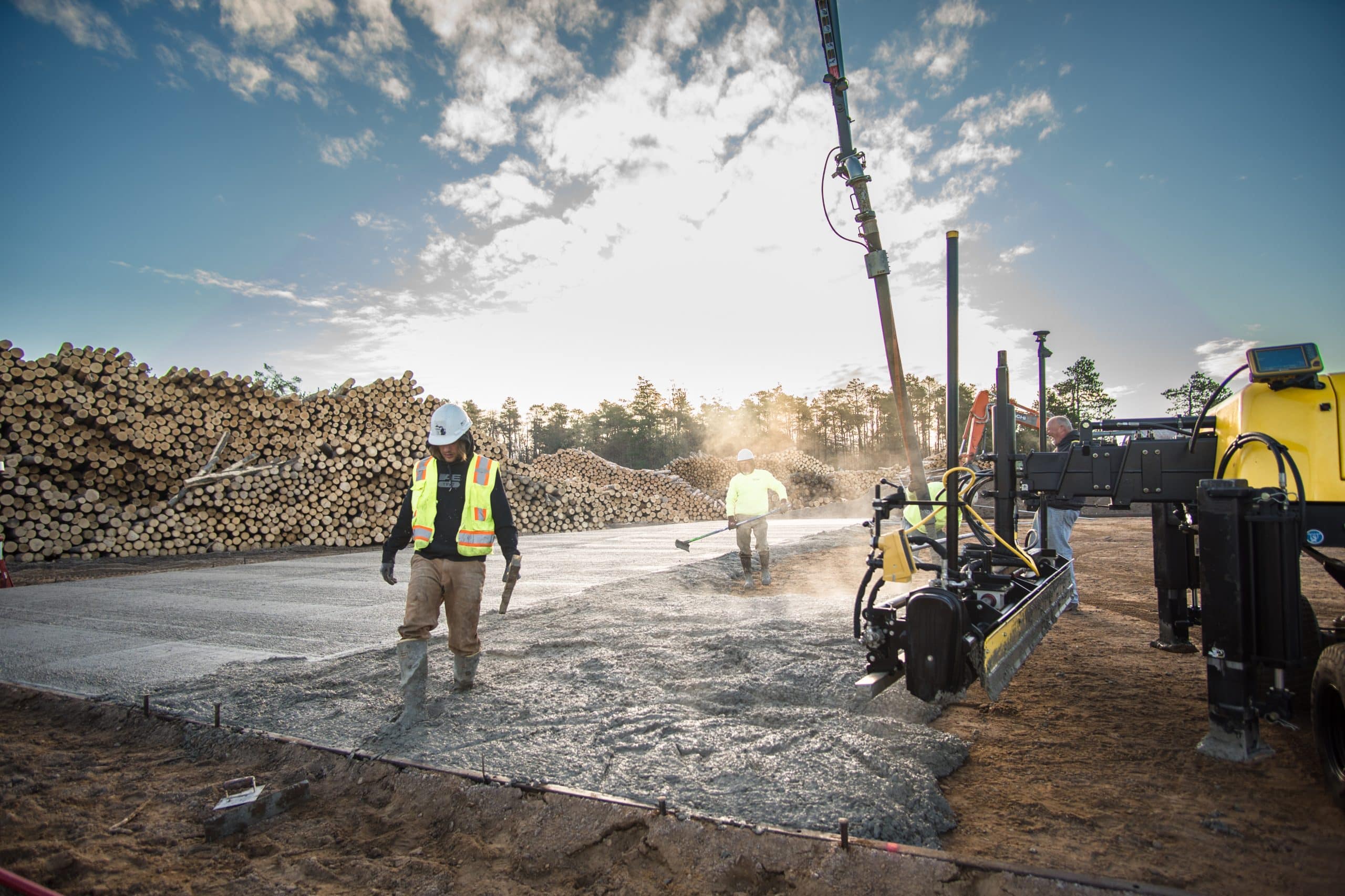
Fiber reinforcement is an internal reinforcement method where discrete fibers are mixed directly into the concrete at the batching plant. Instead of placing rebar or welded wire mesh on-site during the pour, fibers are already suspended throughout the concrete mixture before it arrives at the job.
The most common type used in construction is synthetic fiber reinforcement — like Forta-Ferro fibers produced by Forta Corporation. These engineered fibers are designed to distribute evenly throughout the entire thickness of the concrete slab, providing reinforcement in all directions rather than just along predetermined rebar lines.
HOW IT WORKS
The Fiber Reinforcement Process
Batching at the Plant
The specified quantity of fibers is added to the concrete mix during batching. This ensures complete, uniform distribution before the truck arrives at the job site.
Even Distribution Throughout
As concrete is poured and finished, fibers become integrated throughout the slab's full depth — top, middle, and bottom. No placement or repositioning needed.
No Displacement Risk
Unlike rebar or mesh, there's nothing to push down or shift out of position during pouring and vibration. The reinforcement is already part of the mix.
Engineered to Spec
The engineer determines the exact volume and type of fibers needed based on the project's structural requirements, soil conditions, and intended use.
THE CHALLENGE
The Displacement Problem Traditional Reinforcement Faces

When mesh or traditional rebar is laid down on the slab before pouring, a critical issue arises: displacement during the concrete pour. Heavy concrete and vibration can push reinforcement down or shift it out of position — even with chairs or supports in place.
This isn't a contractor error. It's a physics problem inherent to the method. Once reinforcement gets displaced from its intended depth, the concrete's protective cover changes, and the reinforcement's effectiveness diminishes.
Fiber reinforcement eliminates this problem entirely. The fibers are already part of the mix, so there's nothing to displace.
KEY BENEFITS
Why Engineers Choose Fiber Reinforcement
Even Distribution
Reinforcement throughout the entire slab thickness, not just where rebar is placed. Fibers protect against crack propagation in all directions.
No Placement Labor
Eliminates the time required to install, tie, chair, and inspect traditional reinforcement on-site. Faster job execution.
Crack Control
Fibers help control shrinkage cracks and minimize crack width when cracks do occur in the concrete.
ENGINEERING DECISIONS
When Is Fiber Reinforcement the Right Choice?
The decision to use fiber reinforcement instead of traditional rebar depends on several factors — all determined by the project engineer based on specific requirements.
Engineers evaluate:
- ▸ Application type: The intended use of the concrete (foundation, slab-on-grade, industrial floor, etc.)
- ▸ Structural requirements: Load-bearing capacity needed for what will be built on top
- ▸ Soil conditions: Local soil properties, bearing capacity, and site-specific factors
- ▸ Slab thickness and depth: How thick the concrete needs to be for the application
- ▸ Fiber quantity: The engineer specifies the exact volume and type of fibers needed
This is why you might see one project using traditional rebar and another using fiber reinforcement — it's not a matter of preference. It's determined by an engineer based on what that specific project requires.
CONCRETE REINFORCEMENT OPTIONS
Understanding Different Reinforcement Methods
Traditional Rebar
Steel bars placed on-site before pouring. Best for heavy structural loading and applications where reinforcement needs to be in a specific location. Requires careful placement and verification.
Welded Wire Mesh
Pre-fabricated grids of welded wire placed on chairs before pouring. Common in slabs-on-grade. Subject to displacement during pouring if not properly secured.
Synthetic Fiber Reinforcement
Fibers mixed into the concrete at the plant for distribution throughout the full slab depth. Eliminates placement and displacement concerns. Effective for crack control and certain structural applications.
Post-Tension Cables
Steel cables placed within the concrete and tensioned after curing. Used for longer spans and heavy load requirements. Specialized engineering and installation.
Each method has appropriate applications. The engineer's job is to specify which one — or combination — the project needs.
BUILT TO SPEC
The Gerber Approach to Concrete Reinforcement
At Gerber Construction, we don't make reinforcement choices based on convenience or standard practice. Every concrete project is evaluated by an engineer who specifies the reinforcement method, quantity, and placement that meets the project's actual requirements.
On projects using fiber reinforcement like Forta-Ferro, we specify the exact fiber volume, ensure proper batching at the plant, and confirm even distribution throughout the slab. The same rigor applies whether the project calls for traditional rebar, welded wire mesh, post-tension cables, or fiber reinforcement.
The method changes based on the engineering requirements — not the other way around.

READY TO BUILD?
Let's Talk About Your Concrete Project
Whether your foundation needs traditional reinforcement or fiber reinforcement concrete, the key is working with contractors who follow engineering specifications, not shortcuts or assumptions.